Making Sense of the Recent Pullback
If the past few weeks have felt like a bit of a roller coaster in the market, you’re not alone. It started with a 1.6% jump in the S&P 500 the day after the midterm elections, its best day in three months. The very next day, it fell 4.4%, and it’s been mainly down ever since, ending last week more than 10% below its October high.
The election may have sparked volatility, but since then, worries about AI spending, stubborn inflation, and the prospect of more Fed rate hikes have kept the pressure on. We’ll get to those below. First, a quick look at midterms, since the volatility started on the heels of the election and history offers some reassuring perspective.
What history says about midterms
Markets like predictability.
Midterm years can be bumpy, but post-election returns have often been positive, regardless of who wins.
- Since 1974, the S&P 500 has gained an average of just 1.7% from August 1 through Election Day in midterm years. In the six months after the election, it has averaged 12.4% and has been positive all 13 times (1).
- The S&P 500 has averaged roughly a 15% return in the year after a midterm election since 1950 (2).
Once the results are in, businesses and investors can plan around what’s ahead, and money waiting on the sidelines can get put to work, which may help explain the gap between pre- and post-election returns.
Markets have also grown through Republican, Democratic, and split control of government. Businesses adapt and consumers keep spending through political change.

Hypothetical Growth of $1 Invested in the S&P 500 Index and Party Control of Congress January 1926–December 2025 – Source: Dimensional Fund Advisors
That resilience is reassuring, but it doesn’t explain the recent downturn. For that, we need to look at AI, inflation, and interest rates.
AI selloff
It’s no secret that AI has been one of the market’s biggest drivers over the past few years. Lately, that momentum has cooled as investors question whether the massive spending on AI infrastructure will pay off. The election results also added worry that energy policy changes could restrict the AI buildout. And of course, the surprise departure of Nvidia’s CEO, followed by reports that the SEC is looking into Nvidia’s financial reporting, hasn’t helped. Even Anthropic’s IPO last week, which many hoped would revive the AI trade, couldn’t turn sentiment around.
While these concerns are AI focused, AI has become such a big part of the market that its ripple effects reach well beyond tech. When the market’s biggest leaders stumble, they can pull the whole market down with them, and nervous investors tend to sell broadly.
Beyond AI, rising inflation and the prospect of higher interest rates have weighed on the broader market as well.
Inflation, rates, and the Fed
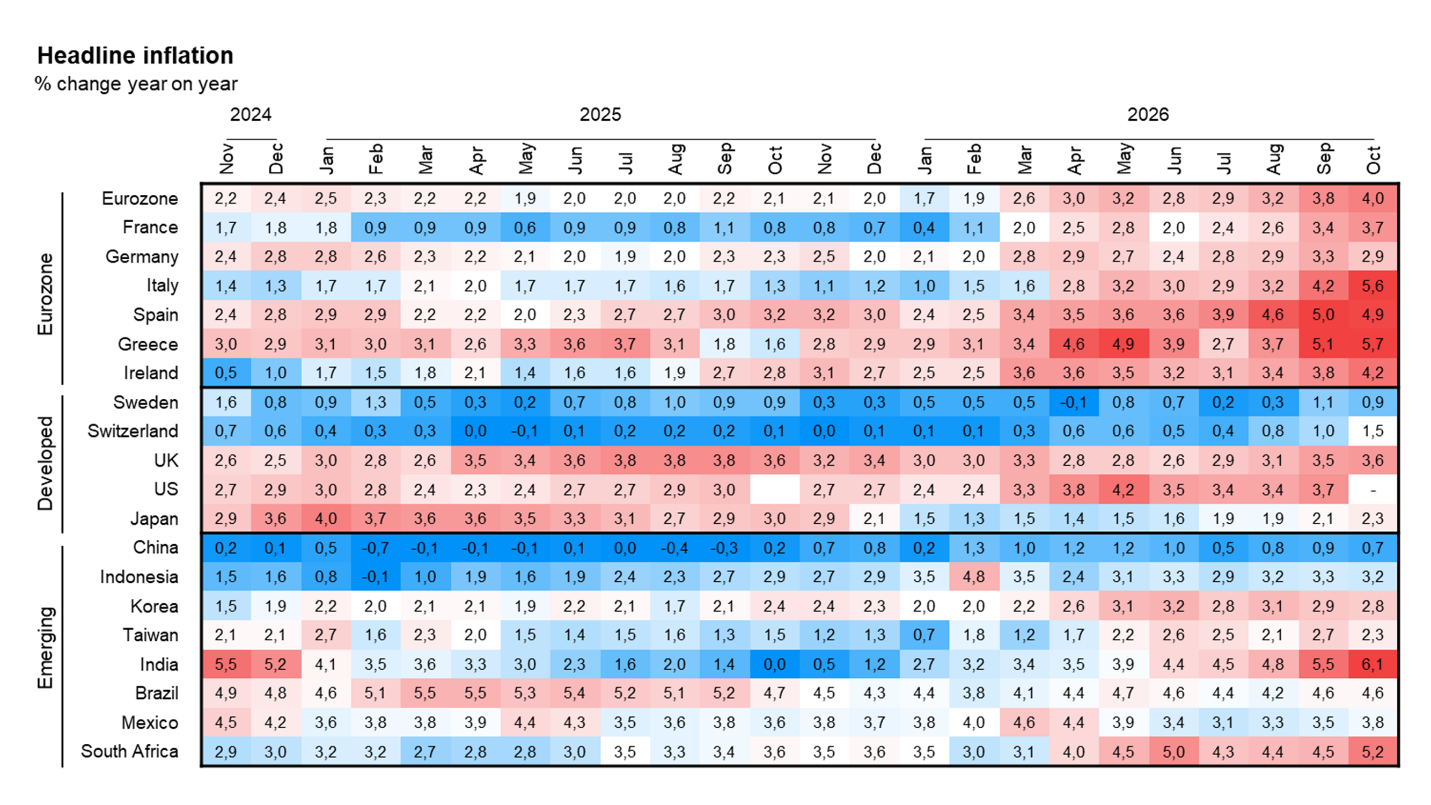
Inflation has been stubborn and picking up steam, reaching 3.7% in September.
As the chart below shows, US inflation has consistently been above the Fed’s 2% target and inflation is picking up globally.
Source: JP Morgan
With inflation persistent and increasing, the Fed has turned to raising interest rates, its main tool for getting inflation under control. It raised rates in September for the first time in over three years and is expected to hike again in December. After recent hotter-than-expected inflation data, some Fed members have even floated a larger half-point increase.
Markets have been reacting to all of this, since higher rates can slow growth and make borrowing more expensive. Higher rates have also pushed up the U.S. dollar. This gives the dollar more purchasing power abroad, but it also means other currencies and commodities lose value relative to the dollar. For U.S. investors, that’s been a drag on the international and commodity exposure in portfolios.
While this all sounds pretty negative, higher rates come with a few silver linings. Bonds become more attractive with higher income for investors. And higher rates give the Fed ammunition. A healthy economy with higher rates is actually a good place to be. If growth slows down in the future, the Fed has room to cut rates to stimulate the economy.
It’s also worth remembering that rate cycles go both ways. And some of today’s inflation comes from higher oil prices tied to the conflict in the Middle East. Oil has already started to ease, falling for three straight weeks and down from around $110 a barrel a month ago, though it’s still much higher than a year ago. But if that trend continues, inflation could cool, giving the Fed room to lower rates again. In the meantime, the economy is on fairly solid footing (unemployment is 4.1% and growth was 3.4% last quarter), which puts us in a better position to handle higher rates.
What to expect from rate hikes
Historically, the start of a rate-hiking cycle has brought some initial volatility, but not all pullbacks have been drastic. Looking at the last 18 hiking cycles, the S&P 500 fell an average of about 14% in the year after the first hike (details in chart below). But the speed of rate hikes has made an impact. When the Fed raised rates slowly (waiting at least one meeting between hikes), those drops have been smaller (about 12% vs. 16% in fast cycles) (3).
So far, this cycle has been in line with a slower pace (with a pause in October). And with a current pullback of just over 10% from October’s high, we are within what’s been normal at this stage. That could change if inflation keeps running hot, but it gives some reassurance looking ahead. The chart below shows how each cycle played out.
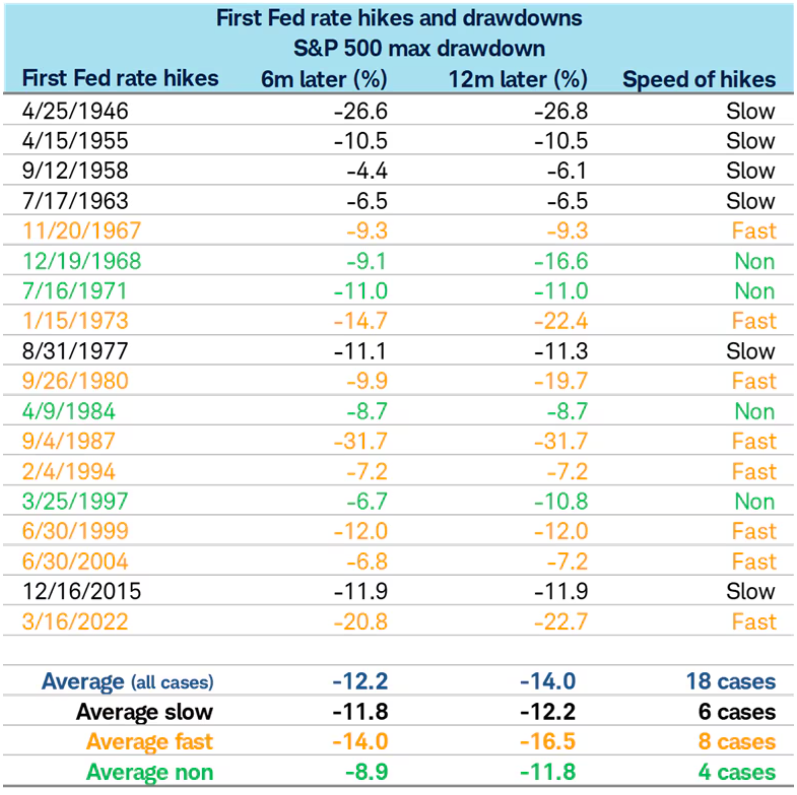
A fast cycle (orange text) is one in which the Fed raises rates at almost every meeting, on average. A slow cycle (black text) is one in which the Fed waits at least one meeting in between hikes, on average. A non-cycle (green text) is two or fewer hikes before a rate cut.
Source: Schwab & Ned Davis Research
My takeaways
Putting this all together, here are a few takeaways to keep in mind as we head toward the end of the year:
- Pullbacks are normal. Declines like the one we’re seeing now are a regular part of investing, and staying focused on the long term has historically been rewarded.
- The economy has held up well. Recent data on growth, jobs, and consumer spending have been solid, and an economy healthy enough to handle higher rates is a position of strength. It also gives the Fed room to cut rates and support growth if things slow down, and other factors, like lower oil prices, could help inflation cool over time.
- Elections tend to matter less than headlines suggest. Markets have grown under every mix of political control. Policy is always changing, and markets have historically adapted. It’s best not to let short-term speculation and momentum drive long-term decisions about your portfolio.
- Make sure your asset allocation still fits you. Higher expected returns come with bigger swings. If this stretch has been harder to sit through than you expected, a more conservative mix may be a better fit.
- Stay diversified. When the market’s biggest names stumble, owning a mix of different investments can help soften the impact.
- Look for tax opportunities. In taxable accounts, dips can create chances for tax-loss harvesting to help offset gains elsewhere.
If you’d like to take a closer look at your plan and portfolio, please reach out and we can review your specifics.
Sources
- Schwab Center for Financial Research, via Advisor Perspectives (S&P 500 price return, data as of August 14, 2026)
- Capital Group, “How U.S. midterm elections may affect markets”
- Liz Ann Sonders and Kevin Gordon, “Take a Hike: Rate Hikes and Market Impacts,” Charles Schwab, September 9, 2026 (Ned Davis Research data, 18 post-WWII tightening cycles)
Disclosures:
Commentary is provided only for informational purposes and should not be taken as investment advice. Commentary is general and investment advice should be unique to each individual. Please consult with a trusted advisor to receive advice specific to you.
Past performance is not a guarantee of future results.
Impact Financial, LLC (“Impact Financial”) is a registered investment advisor. Advisory services are only offered to clients or prospective clients where Impact Financial and its representatives are properly licensed or exempt from licensure.